AI companion market size: what the apps earn
Consumers spent about $327.6 million on AI companion apps in the app stores in the first half of 2026, per Appfigures: $162.8 million on NSFW and romantic apps and $164.8 million on general ones, not counting apps sold only on the web. Per person it is small: Talkie and Xingye's paying users spent an average of $5 each over nine months of 2025. A year on the cheapest plan of the 25 apps below costs a median of $89.
Last updated · 25 rows · Download CSV
| App | A year on the cheapest plan | Cheapest plan | A year on the top plan | Coins, credits or add-ons sold | Price source | Checked |
|---|---|---|---|---|---|---|
| Anima | $40 | Yearly Subscription, web | $120 | None listed | myanima.ai | 2026-11-23 |
| Candy.ai | $48 | Premium (yearly), web | $48 | Yes | candy.ai | 2026-11-18 |
| CrushOn AI | $59 | Standard (annual), web | $1,800 | Yes | crushon.ai | 2026-11-23 |
| Character AI | $60 | (c.ai) lite (monthly), App Store | $95 | None listed | apps.apple.com | 2026-11-19 |
| My Dream Boy | $60 | Plus (yearly), web | $600 | None listed | mydreamboy.com | 2026-11-23 |
| Nectar AI | $60 | Premium (yearly), web | $180 | Yes | nectar.ai | 2026-11-18 |
| SpicyChat AI | $60 | Get a Taste (annual), web | $300 | None listed | spicychat.ai | 2026-11-14 |
| Animates | $64 | whisper (annual), App Store | $320 | None listed | apps.apple.com | 2026-10-18 |
| FantasyGF | $70 | Yearly Subscription, web | $156 | None listed | fantasygf.com | 2026-11-12 |
| Muah AI | $70 | VIP (annual billing), web | $999 | None listed | muah.ai | 2026-11-14 |
| HeraHaven | $80 | HeraHaven Pro (annual), web | $80 | None listed | herahaven.ai | 2026-11-14 |
| Replika | $80 | Plus (yearly), App Store | $90 | None listed | apps.apple.com | 2026-11-19 |
| DreamGF | $89 | Annual (renewal), web | $312 | None listed | dreamgf.ai | 2026-11-14 |
| Talkie | $96 | Talkie+ Standard (yearly), web | $200 | None listed | talkie-ai.com | 2026-10-26 |
| Janitor AI | $99 | janitor+ (annual), web | $99 | None listed | janitorai.com | 2026-11-14 |
| Nomi.ai | $100 | Yearly, App Store | $192 | None listed | apps.apple.com | 2026-11-19 |
| GirlfriendGPT | $110 | Premium (yearly), web | $240 | None listed | gptgirlfriend.online | 2026-11-23 |
| PolyBuzz | $119 | Basic (Android, monthly) | $299 | Yes | play.google.com | 2026-10-31 |
| DarLink AI | $120 | Essential (yearly), web | $396 | Yes | darlink.ai | 2026-11-23 |
| OurDream AI | $120 | Premium (yearly), web | $360 | Yes | ourdream.ai | 2026-11-23 |
| Chai AI | $135 | Chai Ruby, app (annual), Google Play | $255 | Yes | play.google.com | 2026-10-18 |
| Kindroid | $140 | Standard (annual), web | $140 | None listed | kindroid.ai | 2026-11-18 |
| Kupid AI | $179 | Pro (yearly), web | $299 | Yes | kupid.ai | 2026-11-14 |
| AIGirlfriends.ai | $240 | Unlimited Annual (renewal, after introductory period), web | $480 | None listed | aigirlfriends.ai | 2026-11-12 |
| DreamBF | $312 | Monthly (renewal), web | $312 | Yes | dreambf.ai | 2026-10-10 |
How big is the AI companion market? Measured where it can be measured, on the App Store and Google Play, consumers spent about $327.6 million on AI companion apps in the first half of 2026, by Appfigures' estimates. This page uses measured spending only, not forecasts: the app-store figures from Appfigures, the one companion company that has published its own books, where the top-earning apps are today according to our own daily App Store tracker, and what a year of each app costs at its own published prices. Every outside figure is linked and dated; the tracker status and the price table are ours.
AI companion market size in 2026
Appfigures, an app-intelligence firm that estimates spending from App Store and Google Play data, split companion apps into two groups in figures it gave Decrypt, published on July 13, 2026: NSFW and romantic apps, sorted by their store descriptions, age ratings and terms, and general (PG) companion apps. The figures are gross consumer spending worldwide, before Apple and Google take their platform fees, and they leave out apps sold only on the web, such as Joi AI, Candy AI and SpicyChat AI.
- $162.8 million: Consumer spending on NSFW and romantic AI companion apps, first half of 2026.
- $164.8 million: Consumer spending on general (PG) AI companion apps, first half of 2026.
- 214: NSFW and romantic AI companion apps Appfigures identified.
- $427.3 million from 165.3 million downloads: NSFW and romantic AI companion apps since late 2022: consumer spending and downloads.
- nearly twice as many: Downloads of general companion apps compared with romantic ones, first half of 2026.
Added together, the two groups come to about $327.6 million in six months. General companion apps had nearly twice the downloads of romantic ones but earned about the same, so each download of a romantic app brought in close to twice as much. (Source)
The top earners, and where they are now
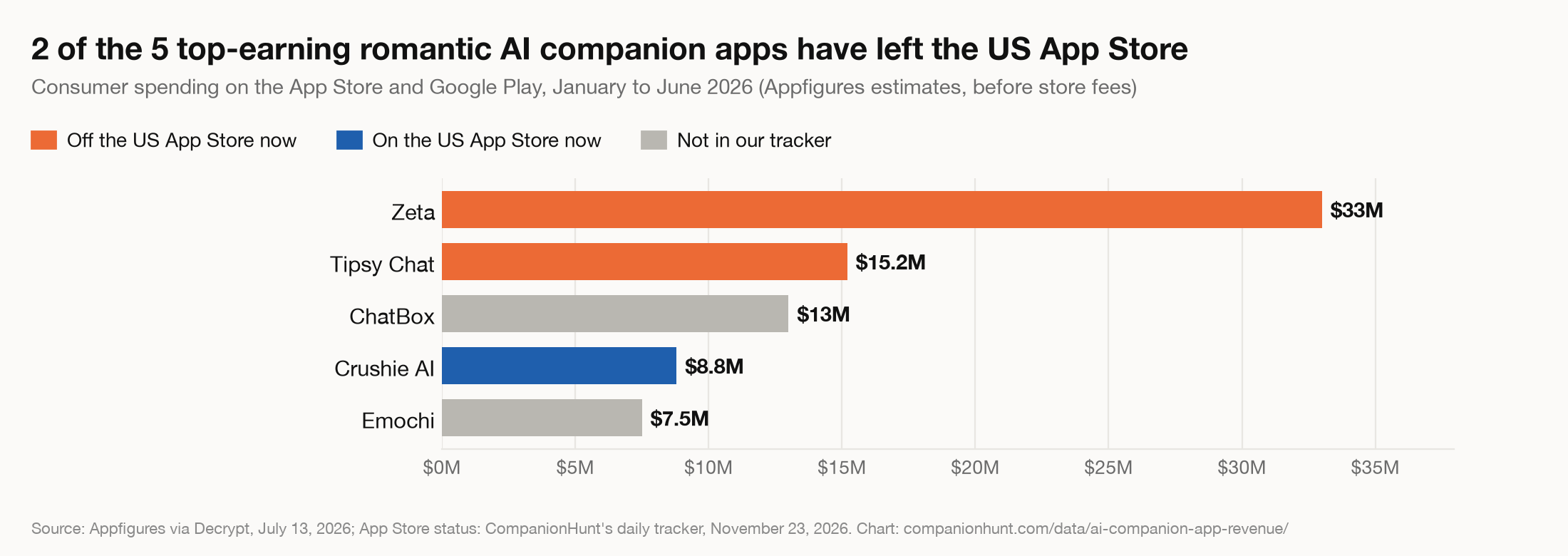
Appfigures ranked the NSFW and romantic companion apps by consumer spending from January to June 2026. We checked each one against our daily App Store tracker, which reads the US App Store every morning:
| App | Consumer spending, January to June 2026 | On the US App Store today |
|---|---|---|
| Zeta | $33 million | No, gone since November 7, 2026 |
| Tipsy Chat: Live Your Story | $15.2 million | No, gone since October 22, 2026 |
| ChatBox: AI Chat Bot Assistant | $13 million | Not in our tracker |
| Crushie AI: Chat & Companion | $8.8 million | Yes |
| Emochi: Chat With Character | $7.5 million | Not in our tracker |
Zeta and Tipsy Chat, both among the biggest earners of the first half, have since left the US App Store, and neither company gave a reason that we could find. Zeta's own notice says its web version and web payments still work. They are not alone: our tracker logged 19 more AI girlfriend and companion apps leaving the US App Store between November 19 and 22, which we reported here. The most-downloaded romantic companion apps in the same six months, by Appfigures' count, were:
- Emochi: 7.9 million downloads
- Amora: A Hint of Your Soulmate: 3.6 million downloads
- Zeta: 3 million downloads
- BIMOBIMO: 2.8 million downloads
- MiraiMind: 2.6 million downloads
What the store figures can't see
The real market is larger than the app-store numbers, for two reasons. First, many companion apps sell on their own websites, where the money goes straight to the company and no store tracker counts it: in our price index, 19 of the 25 apps are cheapest to buy on the web, and for 17 of them the only prices we could find are web prices. Second, some apps earn more from advertising than from their users, as Talkie's books below show.
The 2025 figures
Appfigures' earlier count, reported by TechCrunch on August 12, 2025, covered all companion apps together, defined as apps where you talk to premade or user-made characters meant to have a personality, the way you do on Replika, Character.AI, PolyBuzz or Chai:
- $82 million: Consumer spending on AI companion apps, first half of 2025.
- over $120 million: Appfigures' projection for all of 2025.
- $221 million: Lifetime consumer spending on the category, as of July 2025.
- 64% higher: Revenue in 2025 so far compared with the same period of 2024.
- 337, of which 128 launched in 2025: Active AI companion apps earning revenue, worldwide.
- 89%: Share of category revenue earned by the top 10% of apps.
- about 33 (10%): Apps with $1 million or more in lifetime consumer spending.
- $1.18 in 2025 so far, up from $0.52 in 2024: Revenue per download.
- 60 million, up 88% year on year: Downloads in the first half of 2025.
The 2025 and 2026 counts group the apps differently, so they are not one series; read the growth between them as a direction, not a precise rate. What held in 2025 was concentration: the top tenth of apps took nearly nine dollars in every ten, so most of the hundreds of companion apps earn very little. (Source)
What drives the spending, and what could slow it
Demand: companionship and emotional support. People pay AI companions for connection more than for information. In Elon University's survey of 4,031 US adults in May 2026, 27% of internet users said they use AI chatbots for emotional or social reasons; Pew Research Center's February 2026 survey put the share of US adults turning to chatbots for emotional support or advice at 10%, and for companionship at 4%. That human, social and personal use is what the apps charge for. Research on what it does for mental health is still young; our AI companion statistics list the key studies with their samples and dates.
Technology: what the platforms offer. The money buys features: stronger language models, longer memory, voice calls, and image and video generation, sold in tiers that add more messages, more memory and more media. Higher tiers give character interactions more depth rather than a different experience, as the price index shows plan by plan.
Global, and concentrated. The spending figures above are worldwide, and the top platforms are run from around the world: Zeta by Scatterlab in Seoul, and Talkie by a Singapore company owned by MiniMax Group, which is listed in Hong Kong. Growth has gone mostly to a few apps, as the concentration figures below show.
Regulation: the key risk. 13 AI companion and chatbot laws in 11 US states take effect in 2027 (our tracker), and Apple has told developers of apps with romantic companion features to declare them by a deadline in January 2027 (our report). Regulatory changes like these decide where and to whom the apps can be sold, and the store figures on this page count only what is sold in the stores.
One company's books: Talkie and Xingye
Most companion companies are private and publish nothing. The exception is MiniMax Group, which owns Talkie (sold outside China) and Xingye (its mainland China version), and which listed in Hong Kong. Its prospectus, filed on December 31, 2025, reports the two apps together as one product line. All figures are in US dollars, as printed. They are the last per-app figures MiniMax has published: its results for 2025 and for the first half of 2026 report Talkie and Xingye only inside a wider AI-native products line that also holds Hailuo AI and its other apps.
| Period | Revenue | Paid by users (subscriptions and top-ups) | Online marketing services | Paying users | Average monthly users | Average spend per paying user |
|---|---|---|---|---|---|---|
| 2023 | $758 thousand | $758 thousand | none reported | 119,700 | 2.9 million | $6 |
| 2024 | $19.5 million | $4.9 million | $14.6 million | 585,500 | 14.7 million | $8 |
| Jan-Sep 2024 | $13.5 million | $3.6 million | $9.9 million | 489,100 | 12.4 million | $7 |
| Jan-Sep 2025 | $18.8 million | $7.6 million | $11.2 million | 1,390,400 | 20.1 million | $5 |
Three findings follow from the printed numbers. First, advertising, not subscriptions, paid for most of it: online marketing services were 75% of Talkie and Xingye's revenue in 2024 ($14.6 million against $4.9 million paid by users) and still 60% in the first nine months of 2025. Second, paying users spend little: an average of $8 each in 2024 and $5 over nine months of 2025, far below the price of a month of most companion subscriptions. MiniMax says the fall came from reaching a wider, lower-spending audience. Third, the paying base grew fast anyway, to 1.39 million paying users in the first nine months of 2025, against 20.1 million people using the apps in an average month.
MiniMax calculates average spending per paying customer as the product's revenue from in-app top-ups and subscriptions divided by the number of paying users in the period; a paying user is anyone who made at least one payment in the period. Because a paying user is anyone who paid once in the period, a person who bought a single small pack counts the same as a yearly subscriber, which is why the average is so low. (Source)
What a year of each app costs
The table at the top of this page turns each app's own prices into a year: on its cheapest plan, and on its most expensive one. The median app costs $89 a year on its cheapest plan, from $40 for Anima to $312 for DreamBF. 9 of the 25 apps also sell coins, credits, packs or add-ons on top, which is where a heavy user's bill climbs past the subscription. Prices in this edition were checked between October 10, 2026 and November 23, 2026; each row links its source.
Set against the Talkie figures, the table shows the gap between what apps charge and what most users pay. List prices are what a committed user spends; the average paying user spends far less, and most users pay nothing at all. For a reader deciding whether to pay, the useful comparison is the price index, which lists each app's cheapest monthly route and what the money buys.
Method
The table is computed at build time from each app's own record on this site, the same record behind its pricing page and the price index, so the three always agree. A year on the cheapest plan is the lowest recurring subscription on any channel, converted to a monthly price and multiplied by twelve (a yearly plan counts at its yearly price, a weekly plan at fifty-two weeks). A year on the top plan uses the most expensive plan the app sells, paid the cheapest way that plan allows for a year; add-ons that sit on top of another plan are not counted as a plan. Introductory discounts are excluded. The coins column says whether the app also sells one-off packs, credits, metered usage or add-ons beyond the subscription, which is where heavy users spend more. Prices come from the app's own in-app paywall or its official pricing or help page, dated; a store's in-app purchase list is never used. Retired apps and general-purpose assistants are excluded. The market figures above the table are not ours: each is quoted from the named publisher with its date and link, and the Talkie and Xingye figures are copied from MiniMax's prospectus, with totals formed only by adding the printed lines. Left out because they are no longer on the US App Store and we could source no plan sold elsewhere: Intimate, EVA AI, Tipsy Chat, Zeta.
Cite this
CompanionHunt Research, "AI companion market size: what the apps earn", updated November 23, 2026. https://companionhunt.com/data/ai-companion-app-revenue/In a sentence: Consumers spent about $327.6 million on AI companion apps in the App Store and Google Play in the first half of 2026 (Appfigures, via Decrypt), and 2 of the five top-earning romantic companion apps have since left the US App Store (CompanionHunt's App Store tracker).
Free to quote, screenshot or put in a deck with a link to this page. Please keep the count with the figure, and cite the primary source linked in each row for any single case.
Frequently asked questions
How big is the AI companion market?
Measured on the app stores, consumers spent about $327.6 million on AI companion apps in the first half of 2026: $162.8 million on NSFW and romantic apps and $164.8 million on general ones, according to Appfigures' estimates reported by Decrypt. The figures are gross, before Apple's and Google's fees, and they leave out apps sold only on the web, such as Candy AI and SpicyChat AI, so the whole market is larger.
Which AI companion apps earn the most?
Among NSFW and romantic apps in the first half of 2026, Appfigures ranked Zeta first at $33 million, then Tipsy Chat: Live Your Story at $15.2 million and ChatBox: AI Chat Bot Assistant at $13 million. Zeta and Tipsy Chat have since left the US App Store, by our daily tracker. Revenue is concentrated: in Appfigures' 2025 count, the top tenth of companion apps took 89 percent of the money.
How much does the average person spend on an AI companion?
Less than the list prices suggest. The only company that has published the figure, MiniMax, said paying users of Talkie and Xingye spent an average of 8 dollars each in 2024 and 5 dollars over the first nine months of 2025. Most payers buy a short plan or a small pack rather than a year.
Do AI companion apps make more from subscriptions or from ads?
For Talkie and Xingye, ads. MiniMax's prospectus shows online marketing services earned about three times what users paid directly in 2024, though the gap narrowed in 2025 as subscriptions grew. Apps without ads, such as subscription-only companions, depend entirely on what users pay.
Does MiniMax still report Talkie's revenue?
No. Since listing in Hong Kong, MiniMax's annual results for 2025 and its results for the first half of 2026 report Talkie and Xingye only inside a wider AI-native products line that also includes Hailuo AI and its other apps. The per-app figures on this page are the last ones it published, in its prospectus of December 2025.
What does a year of an AI companion app cost?
The table above shows a year on each app's cheapest plan and on its top plan, computed from the app's own paywall or pricing page and dated. Coins, credits and add-ons come on top for apps that sell them, which the coins column marks.
Where do these numbers come from?
The 2026 market figures are Appfigures data as reported by Decrypt in July 2026, and the 2025 figures Appfigures data as reported by TechCrunch in August 2025. The Talkie and Xingye figures are copied from MiniMax Group's prospectus filed with the Hong Kong Stock Exchange in December 2025. Where each top app is today comes from our own daily App Store tracker. The per-app prices are our own records, each linked to its source and dated.
Can this data be reused?
Yes. The table and chart are free to cite and reuse with a link back, under the Creative Commons Attribution licence. Download the CSV above, or use the cite this line below. Please cite Appfigures and MiniMax for their figures.
Sources
- decrypt.co/373395/this-is-how-much-your-boyfriend-is-spending-on-ai-girlfriends
- techcrunch.com/2025/08/12/ai-companion-apps-on-track-to-pull-in-120m-in-2025/
- www1.hkexnews.hk/listedco/listconews/sehk/2025/1231/2025123100025.pdf
- www1.hkexnews.hk/listedco/listconews/sehk/2026/0302/2026030202837.pdf
- www1.hkexnews.hk/listedco/listconews/sehk/2026/0826/2026082600680.pdf