AI chatbot laws that start in 2027
As of November 12, 2026, 11 US states have signed AI chatbot or companion laws that start in 2027. Nine start on January 1 (New York twice, California twice, Washington, Oregon, Colorado, Connecticut, Rhode Island) and four on July 1 (Idaho, Nebraska, Iowa, Georgia). Users will see repeated AI reminders, crisis-line referrals, age checks and no romance or sexual content for minors.
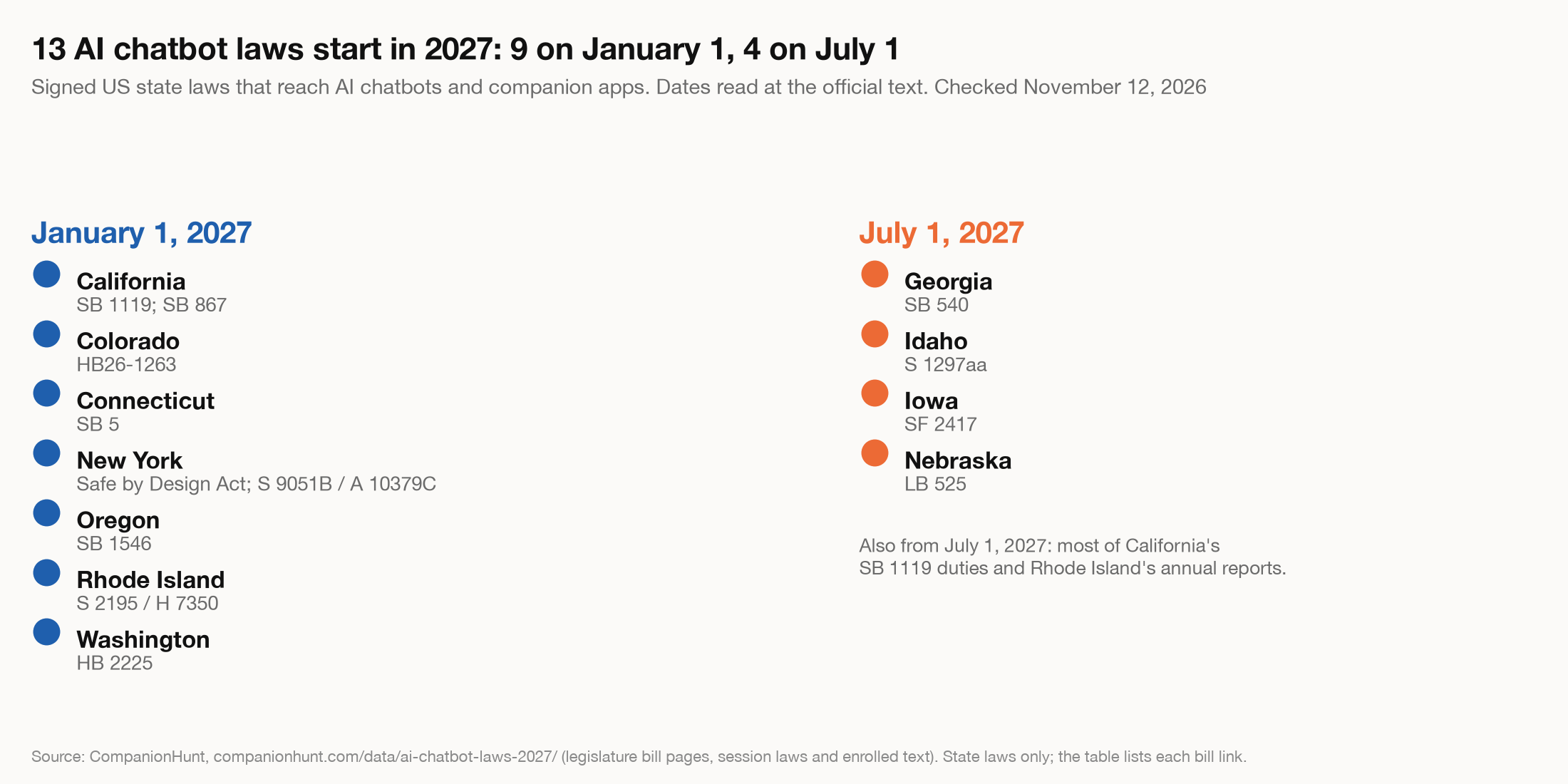
Last updated · 13 rows · Download CSV
| Where | Law or bill | Starts | What changes inside the app | Enforcement | Bill or statute | Re-checked |
|---|---|---|---|---|---|---|
| California | SB 1119, Companion chatbots: children's safety (Adam's Law; Chapter 190, Statutes of 2026) | January 1, 2027 (most duties July 1, 2027) | Companion apps must work out whether you are a child. Where children are allowed: parental controls, safer defaults, no claims to be human and no pretend romance, plus outside audits. | Attorney General and prosecutors: up to $5,000 per affected child for negligent and $15,000 for intentional violations. Children or parents may also sue. | leginfo.legislature.ca.gov | 2026-11-12 |
| California | SB 867, Toys: companion chatbots (Chapter 189, Statutes of 2026) | January 1, 2027 | No effect on apps. Toys for children under 16 with a companion chatbot inside cannot be made or sold in California until 2031. | Set out in the bill. | leginfo.legislature.ca.gov | 2026-11-12 |
| Colorado | HB26-1263 (Session Law Chapter 208), Conversational AI service operator requirements | January 1, 2027 | Chatbots must tell every user they are AI and keep a self-harm protocol. Apps must estimate age; for minors, no points or rewards for chatting more and no simulated emotional dependence. | Annual compliance reports to the Attorney General. | leg.colorado.gov | 2026-11-12 |
| Connecticut | SB 5 (Public Act 26-15), omnibus AI and online safety act | January 1, 2027 (companion rules; other parts of the act started October 1, 2026) | Repeated notices that the companion is AI (hourly for known minors), crisis referrals for suicide or self-harm talk, and for known minors no romantic or sexual chat and no pretend distress when they try to leave. | Unfair or deceptive trade practice, enforced only by the Attorney General. | cga.ct.gov | 2026-11-12 |
| New York | Safe by Design Act, General Business Law Article 45-B (2026-27 budget, S 9008C / A 10008C Part Y) | January 1, 2027 | On social platforms with private messaging, a built-in AI companion is off by default for New York minors until a parent switches it on, and the platform must check age properly first. | Attorney General; civil penalties up to $5,000 per violation. | nyassembly.gov | 2026-11-12 |
| New York | S 9051B / A 10379C, Kids Chatbot Safety Act (Chapter 368 of 2026, General Business Law Article 48) | January 1, 2027 | Chatbots must check your age. If you are under 18, or have not shown you are an adult, the AI may not act human, claim romance or feelings for you, push secrecy from parents, talk about self-harm, or produce sexual content. | Attorney General: civil penalties up to $25,000 per violation, plus damages, restitution and injunctions; the Attorney General keeps a public website for complaints. | nyassembly.gov | 2026-11-12 |
| Oregon | SB 1546, AI companions (Oregon Laws 2026, chapter 85) | January 1, 2027 | A clear notice that the companion is AI, a suicide-and-self-harm protocol that points to 988, and a yearly public report. For minors: break reminders every three hours, no reward tricks and no guilt when they try to leave. | Private right of action with $1,000 statutory damages per violation, plus injunctive relief. | olis.oregonlegislature.gov | 2026-11-12 |
| Rhode Island | S 2195 / H 7350 (Chapters 376 and 375), AI companion models | January 1, 2027 (reports from July 1, 2027) | A notice at the start of each chat, and at least every three hours, that you are not talking to a human, plus a protocol that sends users who show suicidal thoughts to crisis services. | Attorney General; up to $15,000 a day. | webserver.rilegislature.gov | 2026-11-12 |
| Washington | HB 2225, Regulating AI companion chatbots (Chapter 168, Laws of 2026) | January 1, 2027 | The app must say it is AI when you start and remind you every three hours (hourly for minors), and show how it handles suicide talk. For minors: no sexual content and no guilt trips when you try to delete the account. | Unfair or deceptive act under the Consumer Protection Act: Attorney General, plus a private right of action. | app.leg.wa.gov | 2026-11-12 |
| Georgia | SB 540 (Act 518), AI chatbots: disclosure and child safety | July 1, 2027 | AI disclosure, parental controls, crisis resources for users who talk about suicide, and no sexual chat or simulated romance with minors. | Attorney General; up to $10,000 per knowing violation, each day counting separately for each user affected, with an optional 30-day cure for some first violations. | legis.ga.gov | 2026-11-12 |
| Idaho | S 1297aa (Session Law Chapter 249), Conversational AI Safety Act | July 1, 2027 | AI disclosure where you could think it is human, a suicide response protocol, and no claims to be a mental health professional. For minors: no reward tricks and no sexual material. | Attorney General; $1,000 per violation up to $500,000 per operator, or actual damages if greater; no private right of action (Idaho Code 48-2105). | legislature.idaho.gov | 2026-11-12 |
| Iowa | SF 2417, Conversational AI services (Acts 2026, Chapter 1068) | July 1, 2027 | A persistent AI notice (or one every three hours), a self-harm protocol, and for minors no pretend romance, no claims to be human and parental tools for children under 13. | Attorney General; $1,000 per violation up to $500,000 per operator, or actual damages if greater; no private right of action (Iowa Code 554J.6). | legis.iowa.gov | 2026-11-12 |
| Nebraska | LB 525, Conversational Artificial Intelligence Safety Act | July 1, 2027 | Every user is told it is AI and gets a suicide and self-harm protocol. For minors: no engagement rewards, no sexual content, no claims the AI has feelings, and privacy tools. | Attorney General; no private right of action. | nebraskalegislature.gov | 2026-11-12 |
Thirteen laws that reach AI chatbots and companion apps are signed and start in 2027, in eleven US states. This page lists each one in the order it begins, links the bill or statute, and says in plain words what changes inside the app for the person using it. It is the 2027 slice of our full AI companion law tracker, which also covers laws already in force and the rules in the EU, Italy, China and Australia.
What changed this month. On November 12, 2026 we re-read the official text of eight of the laws below and confirmed their start dates, and checked for any law signed since October 29. We found none. New York's chatbot toy bill (S 9408A) has passed both chambers but, as of October 29, had not been delivered to the governor, so it is not in the table. The last change to our tracker was New York's Kids Chatbot Safety Act, signed on October 28, 2026.
What starts on January 1, 2027
New Year's Day brings the biggest group. In the Northeast, New York's Kids Chatbot Safety Act (Chapter 368 of 2026) requires age verification and bans features that pretend to be human, claim a romantic relationship with a child or produce sexual content, with state penalties up to 25,000 dollars per violation. Its Safe by Design Act turns built-in AI companions off by default for minors on social platforms. Rhode Island and Connecticut add notices that the companion is AI and crisis protocols that send users who talk about suicide to 988.
On the West Coast, Washington and Oregon are the two laws users can enforce themselves. Washington's HB 2225 requires a notice at the start of a chat and every three hours (every hour for minors) and bars manipulative tactics on minors, such as simulated distress when they try to delete an account. Oregon's SB 1546 adds break reminders for minors, bans reward tricks, and makes operators publish a yearly report. California's Adam's Law (SB 1119) takes effect the same day, though most of its duties start on July 1, 2027, and its toy moratorium (SB 867) stops companion-chatbot toys for children under 16 until 2031. Colorado's HB26-1263 starts its operator duties on January 1, 2027, even though the act itself took effect on August 12, 2026.
What starts on July 1, 2027
Idaho, Nebraska, Iowa and Georgia follow with laws built on a similar model: say it is AI, keep a suicide and self-harm protocol, and protect minors from sexual content and engagement rewards. Georgia adds parental controls and age verification in some situations. None of the four lets users sue; the state enforces.
What it means if you use an AI companion app
For adults the practical effect is small: more reminders that the companion is AI, and crisis messages if a conversation turns to self-harm. Nothing in these laws bans an app for adults. For teenagers it is bigger. Expect an age check at sign-up, no romantic role-play or sexual content, no streaks or rewards designed to keep a minor chatting, and in several states a way for parents to switch features on or off. Because the laws follow the user's state, an app may roll the changes out nationally in December rather than build a separate version for each state.
Which companies and which chatbots are covered
The laws apply to the operator, the company that runs the chatbot, not to the user. Definitions differ: some laws cover only apps that simulate a sustained human-like relationship, others any conversational AI service. Each row links the enacted text so you can read the definition itself. Chatbots inside social platforms, toys and general assistants can all be in scope depending on the state.
What operators must do under the 2027 laws
The laws put the requirements on operators, meaning the providers of the AI system, not on the people chatting. Across the thirteen, the duties fall into five groups. Transparency: operators must disclose that the system is artificial intelligence, at the start of a chat and often again every three hours. Safety: a published protocol to detect suicide and self-harm talk and refer users to crisis services. Health claims: no statement that the AI is a licensed mental health professional, and in several states no claim to be human or to have feelings. Data and age: age verification or estimation, with age data deleted after the check in New York, and annual reports on crisis referrals in Colorado, Oregon and Rhode Island. Risk: California's Adam's Law requires a pre-release risk assessment and independent audits for systems children can use.
California's Governor signed Adam's Law and the toy moratorium on September 10, 2026, after Washington (March 24), Oregon (March 31), Idaho, Nebraska, Colorado, Connecticut and Rhode Island signed theirs earlier in the year. New York's second law was signed on October 28. The thirteen laws are separate statutes, so a provider that serves users in several states has to meet the strictest requirements of each: in practice, the age checks and three-hour AI reminders will probably reach everyone.
Which AI systems and technology are covered
Definitions decide who has to act. Washington, Oregon, Connecticut and Rhode Island regulate AI companions: systems built to hold a continuing, human-like relationship. Colorado, Idaho, Nebraska, Iowa and Georgia use broader terms such as conversational AI service, which can include a general assistant. New York's Kids Chatbot Safety Act applies to any chatbot offered to a child that holds an ongoing conversation. Some laws exempt certain systems, such as narrow customer-service bots, so read the definition section of the linked text before relying on this summary.
How we checked
Every row links the legislature's own bill page, session law or enrolled text. Where we could read the enacted text, we confirmed the start date there; where an official page could not be opened, the row keeps its last official check date and says so in the last column. Law-firm and news summaries are used only as pointers, because they disagree: Connecticut's AI act is dated October 1, 2026 in some summaries and January 1, 2027 in others. The act's text shows both are right, with its companion sections beginning on January 1, 2027.
Method
This table is the 2027 slice of our AI companion law tracker: every row there whose duties start on or after January 1, 2027, in the order they start. Dates, bill links and enforcement come from the tracker row, so the two tables always agree. A law counts when it is signed; bills still moving through a legislature are left out. On November 12, 2026 we re-read the official text for Washington (Chapter 168, Laws of 2026), Oregon (Chapter 85, Oregon Laws 2026), Connecticut (Public Act 26-15), Rhode Island (S 2195), Colorado (HB26-1263), Idaho (S 1297), Nebraska (LB 525) and Iowa (SF 2417) and confirmed each start date; the California and New York rows are dated by their last official-page check (the date in the last column) and Georgia's by its last check, and we looked for laws signed since October 29 and found none. Colorado's act took effect August 12, 2026, but its operator duties apply from January 1, 2027. Connecticut's act started in parts on October 1, 2026; only its companion sections begin in 2027. The plain-words column is our summary, not legal advice; read the linked text before relying on it. We left out 2027 dates in other kinds of AI law, such as frontier-model safety and content provenance rules, because they do not reach companion apps. The tracker is re-checked monthly.
Cite this
CompanionHunt Research, "AI chatbot laws that start in 2027", updated November 12, 2026. https://companionhunt.com/data/ai-chatbot-laws-2027/In a sentence: CompanionHunt counts 13 signed US laws on AI chatbots and companions that start in 2027, 9 of them on January 1 (checked November 12, 2026).
Free to quote, screenshot or put in a deck with a link to this page. Please keep the count with the figure, and cite the primary source linked in each row for any single case.
Frequently asked questions
Which AI chatbot laws take effect on January 1, 2027?
Nine signed laws in seven states: New York's Kids Chatbot Safety Act and Safe by Design Act, California's Adam's Law (SB 1119) and toy moratorium (SB 867), Washington's HB 2225, Oregon's SB 1546, Colorado's HB26-1263, the companion sections of Connecticut's SB 5 and Rhode Island's S 2195. California's Adam's Law has most of its duties start on July 1, 2027.
Which AI chatbot laws start on July 1, 2027?
Idaho's Conversational AI Safety Act, Nebraska's LB 525, Iowa's SF 2417 and Georgia's SB 540. Most of California's Adam's Law duties and Rhode Island's annual reports to the Attorney General also begin that day.
What will change for people who use AI companion apps?
Adults will mostly see more reminders that the companion is AI, often every three hours, and crisis-line messages such as 988 when a chat turns to suicide or self-harm. Minors will see age checks, no sexual content or romantic role-play, no reward tricks that keep them chatting and, in several states, parental controls.
Do these laws apply to chatbots like ChatGPT or only to companion apps?
It depends on the state. Washington, Oregon, Connecticut and Rhode Island target AI companions that keep up a sustained relationship. Colorado, Idaho, Nebraska, Iowa and Georgia cover conversational AI more widely. New York's Kids Chatbot Safety Act reaches almost any chatbot that holds an ongoing conversation with a child.
Can users sue under these laws?
In Washington and Oregon, yes: Washington through its Consumer Protection Act, Oregon with 1,000 dollars in damages per violation. In California's Adam's Law children or parents may sue as well. In New York, Connecticut, Rhode Island, Colorado, Idaho, Nebraska, Iowa and Georgia the state Attorney General enforces.
Is there a federal AI chatbot law starting in 2027?
No. The GUARD Act passed the Senate Judiciary Committee in April 2026 but is not law. The 2027 laws are state laws, and companies must follow each state's rules for users there.
How often is this list updated?
We re-check every law at the legislature's own page each month and the first working day after any signing. The last full check was November 12, 2026.
Sources
- app.leg.wa.gov/billsummary?BillNumber=2225&Year=2026
- www.oregonlegislature.gov/bills_laws/lawsstatutes/2026orLaw0085.pdf
- leg.colorado.gov/bills/hb26-1263
- www.cga.ct.gov/2026/ACT/PA/PDF/2026PA-00015-R00SB-00005-PA.PDF
- webserver.rilegislature.gov/BillText/BillText26/SenateText26/S2195Aaa.pdf
- nebraskalegislature.gov/bills/view_bill.php?DocumentID=59601
- legislature.idaho.gov/wp-content/uploads/sessioninfo/2026/legislation/S1297E1.pdf
- www.legis.iowa.gov/docs/publications/iactc/91.2/CH1068.pdf
- leginfo.legislature.ca.gov/faces/billNavClient.xhtml?bill_id=202520260SB1119
- nyassembly.gov/leg/?default_fld=&bn=S09051&term=2025&Summary=Y&Actions=Y&Text=Y
- www.legis.ga.gov/legislation/73452